
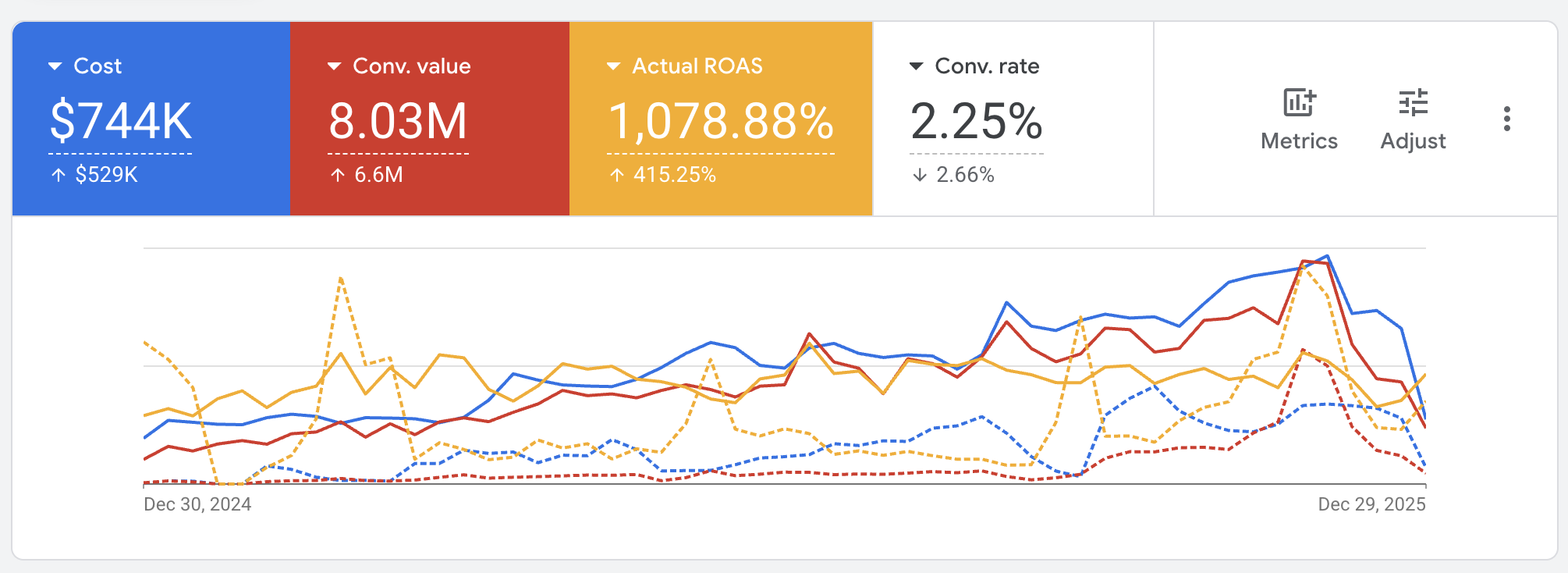
$8M In Revenue On $744K In Ad Spend
A US clothing brand was running Google Ads as a "set and forget" channel, Performance Max doing most of the work, Shopping in the background, brand search uncontrolled, and a Merchant Center feed quietly bleeding visibility across most of the catalogue. Over twelve months, with a feed rebuild, a brand/non-brand split, and PMax structured properly around new customer acquisition, revenue grew from $1.43M to $8.03M while ROAS climbed from 6.6x to 10.79x, the rare scale-up where the cost curve moved the right way.
- Rebuilt the Merchant Center feed from the ground up, titles, GTINs, high-res images, structured attributes, and custom labels for margin tier and season. Most of the catalogue moved from low-visibility to actively serving.
- Pulled brand search out of Performance Max with proper negatives and built a dedicated brand campaign, stopped letting PMax claim credit for cheap branded clicks that would have converted for free.
- Turned on New Customer Acquisition in PMax with value bidding, the channel started finding net-new buyers instead of recycling existing customers at flattering CPAs.
- Segmented the catalogue by margin tier and seasonality with custom labels, different tROAS targets per tier so the algorithm wasn't treating every SKU as equally valuable.
A Channel On Autopilot, And A Feed That Was Quietly Holding Everything Back.
The brand had been running Google Ads for years. PMax was on, Shopping was on, the team checked the dashboard weekly, and the numbers had drifted into "fine" territory. The problem was that "fine" was masking three structural issues: a broken feed limiting how much of the catalogue Google could actually serve, brand cannibalisation inflating ROAS while disguising real performance, and zero distinction between new and existing customers anywhere in the campaign structure.
A Merchant Center Feed Bleeding Visibility
Clothing feeds are unusually complex, sizes, colours, materials, seasonal variants, and this one had drifted hard. Product titles were inconsistent (some led with brand, some with product type, some with neither). GTINs were missing or wrong on a large portion of SKUs. Images were a mix of high-res lifestyle and low-res pack shots. Google product categories were misassigned across whole segments. The result: a meaningful chunk of the catalogue was simply not serving at scale on Shopping, and PMax was working with one hand tied behind its back.
Performance Max Eating Brand Search
PMax was running broad with no brand exclusions. Every branded search, people Googling the brand name directly, already intent-loaded, was being eaten by PMax and credited to it. Reported ROAS looked great because PMax was absorbing the cheapest, highest-intent clicks in the account. The actual incremental work, finding net-new buyers who'd never heard of the brand, was getting almost no budget and no measurement clarity.
No New Customer Acquisition Lever
Google's NCA toggle in PMax was off. The algorithm was being asked to find conversions, and it was doing exactly that, by leaning heavily into existing customers and warm retargeting pools where conversion rates were highest and CPAs were lowest. Looked clean on the dashboard. Catastrophic for actual top-of-funnel growth, because the new-customer rate was quietly flat-lining while reported numbers kept smiling.
Catalogue Treated As One Tier
Margins varied dramatically across the catalogue, some categories ran 60%+ contribution margin, others under 20%, and the algorithm had no idea which was which. Every SKU was being optimised against the same blended tROAS. Low-margin items were getting over-funded; high-margin items weren't getting pushed hard enough. The structure made it impossible to actually express the brand's economics in the bidding.
Fix The Inputs Before Trying To Fix The Outputs.
Google rewards good inputs more than almost any other channel, a clean feed and a correct campaign structure outperform clever bidding every time. We rebuilt the foundation, separated branded from non-branded properly, then let PMax do what it actually does well: scale net-new customer acquisition on a properly-tuned feed.
Merchant Center Feed Rebuild
The single highest-leverage piece of the engagement. Rebuilt the feed end to end:
- Titles standardised on a clean pattern (Brand + Product Type + Key Attribute + Colour/Size)
- GTINs sourced and populated across the catalogue
- Images upgraded to consistent high-res, white-background hero + secondary lifestyle
- Product categories corrected to Google's taxonomy
- Structured attributes filled out properly, material, gender, age group, size system
- Custom labels added for margin tier, season (SS/AW/Evergreen), and lifecycle stage (new launch / core / clearance)
Feed coverage on Shopping moved substantially. PMax started working with a clean signal across the full catalogue instead of pushing a narrow set of well-described SKUs.
Merchant Center Feed RebuildBrand vs Non-Brand Separation
Pulled brand terms out of PMax with proper brand exclusions at the campaign level. Built a dedicated brand search campaign, cheap CPCs, near-100% impression share on terms the brand should never have been paying PMax rates for. PMax was now competing for non-brand conversions only, which is the work that actually scales the business. Reported ROAS on PMax dropped slightly in week one, and that was the point. The number was finally measuring something real, and the team could now scale into it with confidence.
Brand Campaign SeparationPerformance Max With New Customer Acquisition + Value Bidding
Restructured PMax around what it's actually good at:
- Switched bidding to Maximise Conversion Value with target ROAS, with conversion value rules differentiating new vs returning customers
- Turned on New Customer Acquisition with value mode, weighting new customers materially higher
- Split asset groups by margin tier (using the custom labels added in the feed work), with different tROAS targets per group, high-margin asset groups pushed hard, low-margin held at a higher target
- Layered first-party audience signals (purchaser lists, high-intent visitors) without restricting the campaign to them
PMax started finding net-new customers in volume the prior structure had been suppressing. Conversion rate dipped slightly, expected, because the audience mix was shifting toward colder traffic, but revenue and ROAS both moved the right way because the customers being acquired were higher-LTV and more incremental.
PMax + New Customer AcquisitionSearch Query Hygiene & Negative Keyword System
Built a recurring negative keyword process across Shopping and DSA: weekly search term review, negatives added at the right level (campaign vs account), pruning of irrelevant query types ("free," "diy," "amazon," "wholesale," competitor names without intent). Stopped leaking material spend against queries the brand was never going to convert. Same budget, materially more efficient, which compounded with every other change in the account.
Search Query HygieneSee What We've Done For Other Brands.
.webp)

Ready to stop guessing?
Apply for a free Paid Ads Audit + Custom Scaling Plan Powered By Our Predictable Scaling Quadrant™ Method. We'll pinpoint exactly where your budget is leaking and show you a clear path to profitable scale.
Joined by 1,500+ businesses