
42% More Conversions For 18% Cheaper
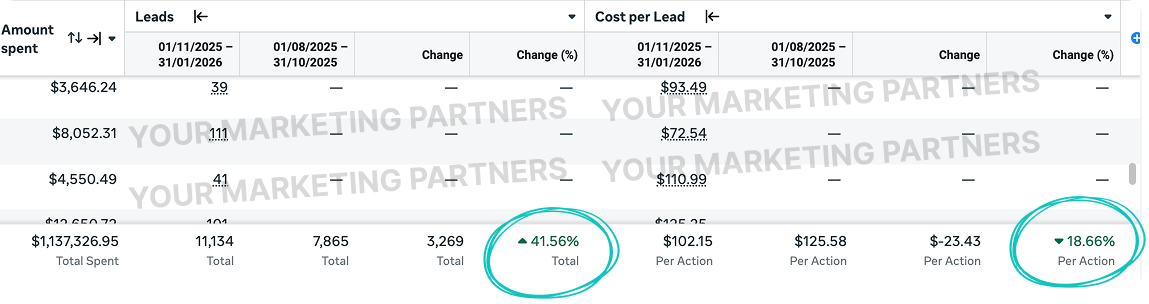
A US consumer finance brand was scaling Meta spend hard but every push at growth came with the same pattern: lead volume went up, lead quality went down, sales team complained, CPL eventually crept up again. Three months after rebuilding the lead-value model, inserting a proper pre-qualification quiz, and wiring speed-to-lead into the funnel, they were generating 11,134 leads at $102 CPL, 42% more leads, 19% cheaper than the prior quarter, with the sales team finally working leads they actually wanted.
- Stopped optimising for "Lead" as a single event. Built a tiered value model (Lead → Eligible → Qualified → Application Started → Funded) and pointed the algorithm at the deeper, more valuable events.
- Inserted an eligibility quiz before the form, pre-qualified prospects on income, credit profile, intent, and location before they ever became a paid lead.
- Built a compliance-safe creative system that surfaced the hook before the disclaimer, instead of burying the offer behind rate disclosures.
- Wired Meta leads directly into the sales dialer, speed-to-lead went from hours to under 90 seconds, which is the single biggest unit-economics lever in finance.
A Finance Account Treating Volume As The Goal, When Quality Was The Bottleneck.
The brand was spending heavily and getting leads. The problem wasn't at the top, it was everything downstream. The sales team had quietly stopped trusting Meta leads. Application completion rate was poor. Cost per funded loan was rising even when reported CPL looked acceptable. The account was structurally optimised for the wrong outcome, working inside constraints the team didn't fully understand, and bleeding economics on speed-to-lead.
Special Ad Category Constraints Treated As An Obstacle, Not A Design Brief
Finance accounts can't target by age, gender, ZIP-level geo, or build custom-audience and lookalike layers the way ecom can. The team had been trying to compensate by stacking interest layers and over-segmenting ad sets, pulling the only levers they thought they had, none of which were actually working under SAC. The lever that did matter under SAC, creative diversity and signal quality, was getting almost no attention.
One Conversion Event, Five Tiers Of Real Value
Meta was optimising on "Lead", meaning any form fill. In reality the brand had five tiers of actual value: Lead, Eligible, Qualified, Application Started, Funded. They were not the same thing, and they didn't pay the same. By pointing the algorithm at the cheapest possible event, the team was teaching it to find people who'd fill in a form, not people who'd qualify, apply, and fund.
No Pre-Qualification, The Form Was The Filter
The lead form sat behind a "Get Your Rate" CTA with zero gating in front of it. Roughly half the leads coming through were ineligible, wrong income bracket, wrong credit profile, wrong residency, sometimes outright fraud. The sales team was burning expensive hours on leads that should never have made it into the CRM in the first place. The form was being asked to do the filtering work a pre-qualification step should have been doing.
Compliance-Heavy Creative Killing The Hook
Every concept was loaded with disclosures, rate disclaimers, and "subject to approval" callouts that swallowed the first three seconds. The ads were watertight from a compliance perspective and emotionally dead from a performance one. Compliance copy has to be there, but it doesn't have to be the first thing the prospect sees.
Speed-To-Lead Wasn't On The Strategy Map
Finance leads are unusually time-sensitive, contact rates drop sharply the longer it takes to reach a new lead, and the conversion gap between a sub-5-minute response and an over-1-hour response is enormous. The team's average response time was several hours. That single number was killing the unit economics of every lead the account was producing, before any optimisation work on the ads side could matter.
Stop Buying Leads. Start Buying Funded Customers.
Finance lead gen is won and lost at the intersection of signal quality, pre-qualification, and speed. We rebuilt around all three. Once the algorithm knew what a valuable lead actually looked like, the team had pre-qualified out the noise, and the sales floor was calling new leads in under two minutes, everything compounded.
Tiered Value Model & Deep-Funnel Optimisation
Built the conversion event stack the account should have had from day one:
- Lead, form filled
- Eligible, passed quiz qualification
- Qualified, sales team verified
- Application Started
- Application Completed
- Funded (with revenue value attached via offline conversion upload from the CRM)
Switched campaign optimisation from Lead → Application Completed, with revenue values flowing back through Conversions API + offline uploads. The algorithm stopped chasing the cheapest form fill and started chasing the people who'd actually fund, which is the metric the business is actually paid on.
Value-Based Bidding & Deep-Funnel OptimisationEligibility Quiz Pre-Qualification
Inserted a multi-step eligibility quiz before the lead form. Filtered on the things that actually mattered:
- Income range
- Employment status
- Residency / state
- Approximate credit band (self-declared)
- Loan purpose / urgency
Ineligible prospects exited gracefully (with educational content, not a hard rejection, protects brand and SEO). Eligible prospects continued to the form with their answers pre-populated. Lead volume dipped briefly. Lead quality moved sharply, and within weeks Meta was finding more eligible prospects because the algorithm was finally getting clean signal on what "good" looked like.
Eligibility Quiz FunnelCompliance-Safe Creative System
Built a creative system that worked with compliance, not around it:
- Hook in the first 3 seconds, disclosure handled in the supporting copy and end-frame
- Pre-approved creative templates so the team could ship without serial rejections
- A library of compliance-safe headline patterns, rate disclosure formats, and CTA framings vetted by legal once and re-used many times
- Creative diversity across angle (debt relief framing, savings framing, opportunity framing, comparison framing) rather than audience diversity (the lever SAC takes away)
The result: creative velocity tripled because the team wasn't getting bounced by ad review every other day, and concepts were finally leading with emotion before disclosure.
Compliance-Safe Creative SystemSpeed-To-Lead Integration
Wired Meta Lead Ads and the website form directly into the sales dialer via the CRM. New leads were being called within 60–90 seconds of submission, automated SMS firing within 15 seconds of that. Contact rate moved significantly. Application-start rate from contacted leads moved with it. This is the highest-leverage operational fix in finance lead gen and almost nobody actually does it properly, because it requires the ads team and the sales ops team to actually build something together, which usually doesn't happen.
Speed-To-Lead WiringSee What We've Done For Other Brands.

Ready to stop guessing?
Apply for a free Paid Ads Audit + Custom Scaling Plan Powered By Our Predictable Scaling Quadrant™ Method. We'll pinpoint exactly where your budget is leaking and show you a clear path to profitable scale.
Joined by 1,500+ businesses