
24% Reduction In Cost Per Application On $657K In Spend Over 4 Months
A real estate operator was generating application volume but bleeding budget on unqualified prospects, generic creative, and a campaign structure that ignored the constraints Meta places on Housing ads. Four months after restructuring around the Special Ad Category reality, plugging the account into a property listing feed, and rebuilding the application flow to pre-qualify intent, they were submitting 10,444 applications at $63 per application, 24% cheaper than the prior quarter on a meaningfully deeper conversion event.
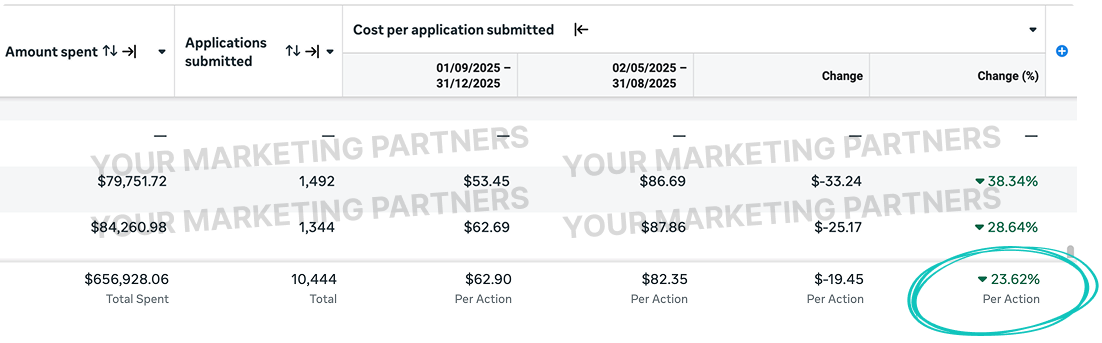
- Designed the account around Special Ad Category (Housing) constraints instead of fighting them, no age/gender/ZIP targeting, no custom audiences/LLA, broad targeting, all the strategic weight pushed onto creative and feed.
- Plugged the account into a live property listing feed and ran Dynamic Listing Ads, every prospect saw real, currently-available inventory in their area, not generic "find your next home" creative.
- Rebuilt the application flow with housing-specific pre-qualification (move date, household size, budget band, credit comfort), filtered out tyre-kickers before they ever became a paid application.
- Pushed optimisation to a deeper funnel event, Application Submitted rather than Lead, so the algorithm started finding people who would actually complete the application, not just click "Apply."
A Housing Account Built Like A Generic Lead-Gen Account.
The brand was treating real estate like any other lead-gen vertical: drive cheap leads, hope quality holds, blame the sales team when it doesn't. The fundamental issue was that Housing on Meta isn't generic lead gen, it sits under Special Ad Category, which strips away most of the targeting levers other verticals lean on. The account had been built as if those levers still existed, and the structural mismatch was showing up in every metric downstream of the click.
Special Ad Category Treated As A Hurdle, Not A Design Brief
Housing ads can't target by age, gender, ZIP-level geo, household income proxies, or build the custom audiences and lookalikes that ecom and standard lead gen rely on. The team had been compensating with stacked interest layers and tight ad-set segmentation, pulling levers they didn't actually have, none of which were doing anything. The two levers that do matter under SAC, creative diversity and feed/inventory quality, were getting almost no work.
Generic "Find Your Next Home" Creative
Every concept ran the same template: lifestyle hero shot, generic copy, "Apply Now" CTA. None of it surfaced the actual inventory, the specific properties, in specific submarkets, at specific price points, that a real prospect would convert against. People looking for housing are looking for a unit, not a brand. The creative was being asked to do the impossible: get someone to apply to nothing in particular.
Application Form Doing The Qualifying Work
The application form was being treated as the conversion goal, but it had no pre-qualification structure in front of it. Anyone who clicked "Apply" hit a full application, and a large share of submissions were ineligible on basics: wrong move timing, wrong budget band, wrong household composition, sometimes wrong city. The leasing team was burning hours processing applications that should never have made it into the CRM.
Optimising On The Wrong Event
Meta was optimising on "Lead", a click-through or initial form interaction, and reported CPL looked reasonable. The actual business event the operator cared about was Application Submitted, and the gap between leads and submitted applications was enormous. The algorithm was being taught to find clickers, not applicants, and it was doing that job well.
Build For The Constraint, Then Let The Feed Do The Work.
Real estate on Meta only really scales when the account is designed around two things that most operators ignore: SAC compliance as a structural reality, and inventory as the creative engine. We rebuilt around both, then pushed the optimisation event deeper so the algorithm was rewarded for finding actual applicants, not curious clickers.
SAC-Native Account Architecture
Stopped trying to slice the audience the team couldn't slice. Restructured into broad-targeted, SAC-compliant campaigns where the only meaningful audience constraint was service-area geo (at the granularity Meta allows under Housing). Removed every interest stack, every layered lookalike, every audience hack the prior structure had been leaning on. The algorithm doesn't need them under SAC, and forcing them in actively hurts delivery. With the audience constraints simplified, the account could finally direct its strategic weight where SAC says it has to live: creative and feed.
SAC-Native Account ArchitectureProperty Listing Feed + Dynamic Listing Ads
Built a live property listing feed and ran Dynamic Listing Ads (Meta's catalogue format for housing) against it. Every prospect saw real units, actual available inventory in their submarket, with the right price, bedroom count, and key amenities surfaced in the creative itself. As units leased and new units came onto the portfolio, the feed updated and the ads followed automatically. This is the single highest-leverage move in real estate paid: it turns the catalogue into the creative, and means the brand never runs out of fresh assets even with high inventory turnover.
Dynamic Listing Ads + Property FeedHousing-Specific Application Pre-Qualification
Inserted a short pre-qualification flow before the full application, three to four questions specific to housing decisions:
- Target move date (this month / 1–3 months / later)
- Budget band
- Household size
- Pets / specific requirements
Prospects who didn't match available inventory were routed to "we'll let you know when something fits" capture (kept the email, didn't burn the leasing team's time). Prospects who matched moved forward into the full application with their answers pre-populated. Application quality moved sharply within the first month, and Meta started finding more qualified applicants because the algorithm was getting clean signal on what a real applicant looked like.
Housing-Specific Pre-QualificationDeep-Funnel Optimisation On "Application Submitted"
Switched campaign optimisation from Lead to Application Submitted, with the event firing server-side via Conversions API the moment a full application hit the system. The shift forced the algorithm to look past the click and find people who would actually complete the process. Cost per click went up. Cost per application came down by 24%. The business metric moved the right way because the optimisation signal finally matched the thing the operator was actually paying for.
Deep-Funnel OptimisationSee What We've Done For Other Brands.

Ready to stop guessing?
Apply for a free Paid Ads Audit + Custom Scaling Plan Powered By Our Predictable Scaling Quadrant™ Method. We'll pinpoint exactly where your budget is leaking and show you a clear path to profitable scale.
Joined by 1,500+ businesses