3.6x Revenue Growth Year-Over-Year
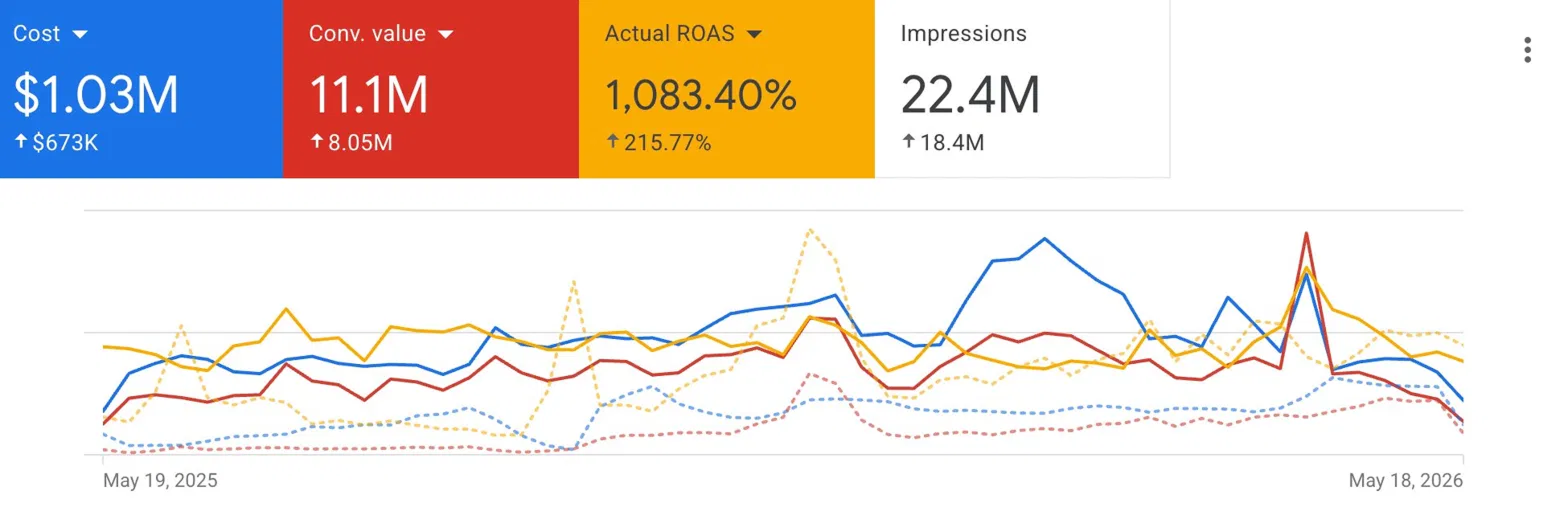
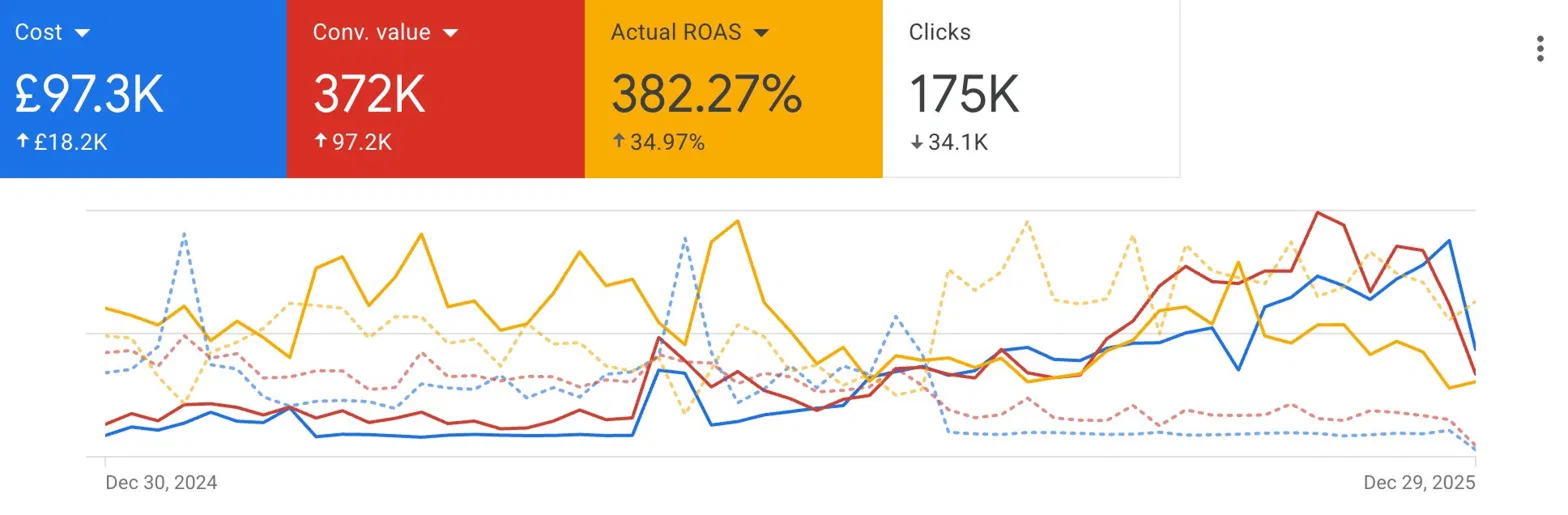
A premium DTC skincare brand had been on Google Ads for years, but the account was stuck in a frustrating pattern: Performance Max was opaque, brand search was being absorbed into PMax credit, and the feed had been on autopilot since launch. The brand was generating revenue, but no one could explain why some months worked and others didn't. Twelve months after a full account rebuild (feed, structure, tracking, audience signals), the account scaled from $3.05M to $11.1M in revenue, an 8.05M-dollar lift on a sustained 10.83x ROAS.
- Restructured the account around a single Performance Max campaign powered by a clean, fully-attributed product feed, with Standard Shopping retained only for top-margin SKUs the algorithm was consistently underweighting.
- Implemented enhanced conversions and server-side GA4 tagging via GTM; conversion accuracy improved by ~31% and Smart Bidding stopped hunting blind on partial data.
- Rebuilt asset groups around the brand's actual product themes (not Google's auto-generated themes), separating skin concerns into distinct asset groups so signals stayed clean.
- Carved out brand search into a dedicated campaign with its own budget cap to stop Performance Max claiming credit for traffic that was already going to convert.
A Brand Spending Big On Google Without Knowing What Was Actually Working.
The brand was already spending a meaningful monthly run rate on Google when we took the account over. Revenue was being generated, but no one (including the previous agency) could explain why the account performed on the months it performed, or why it tanked on the months it didn't. Performance Max was a black box, Shopping was fragmented, and brand search was being credited to whichever campaign got to the conversion first.
Account Structure
Three overlapping Performance Max campaigns, two Standard Shopping campaigns, and a brand search campaign all competing for the same queries. PMax was claiming credit for branded traffic that was always going to convert, inflating ROAS on paper while masking the actual performance of cold acquisition. No campaign exclusions, no brand keyword negatives at the PMax level, and asset groups built around Google's auto-suggested themes rather than the brand's actual product categories. The result: spend distributed by algorithm preference, not by margin or intent.
Tracking & Attribution
Standard GA4 client-side tagging only. No enhanced conversions, no server-side relay, and conversion values were being passed through inconsistently across the product range, some SKUs were reporting transaction value, others were defaulting to a static figure. Smart Bidding was optimising on noisy, partial signal. When we reconciled Google-reported revenue against Shopify, the gap was ~31%, meaning the algorithm had been making bidding decisions on a fraction of the real outcome data for months.
Product Feed & Asset Groups
Feed quality was the silent killer. Titles were truncated, GTINs were missing on ~18% of SKUs, and the product type taxonomy hadn't been updated since the account launched. Performance Max was being fed a messy feed and asked to figure out the rest. Asset groups had been built once at launch and never revisited, high-margin hero products were sharing groups with low-margin add-ons, so the algorithm was bidding identical CPCs across products with completely different unit economics.
We Rebuilt The Account Around Clean Signal, Not Clever Tactics.
Google Ads accounts at this size don't usually fail because the strategy is wrong. They fail because the algorithm is being fed bad data. We fixed the inputs first (feed, tracking, brand isolation) and let the structure do the work.
Tracking & Conversion Data
Implemented enhanced conversions through Google Tag Manager with server-side tagging via Stape. Validated every conversion against Shopify order data and added consistent value passing across the entire SKU range. Within 21 days, Google-reported revenue closed within 4% of Shopify actuals, and Smart Bidding had a clean, full signal to optimise against for the first time. This was the unlock. Every downstream change compounded because the algorithm was finally seeing reality.
Enhanced ConversionsBrand Search Isolation
Built a separate brand search campaign with exact-match brand terms and added those terms as account-level negatives across every Performance Max campaign and Standard Shopping campaign. Within the first month, "true" cold acquisition ROAS on PMax dropped on paper from 7.2x to 4.1x, not because performance got worse, but because we'd stopped letting PMax steal credit for traffic that was already going to buy. Real performance was now visible, which meant we could make real decisions.
Brand IsolationProduct Feed & Asset Group Rebuild
Rebuilt the Merchant Center feed end-to-end: title structure optimised for search intent, GTINs and identifiers cleaned across every SKU, product type taxonomy rewritten to match how customers actually search for the products. Then collapsed the three overlapping PMax campaigns into one, with asset groups split by skin concern (rather than product line), so signal stayed clean within each group. High-margin hero products got dedicated asset groups with their own creative; lower-margin range fillers were grouped by category.
Feed OptimisationAudience Signals & Continuous Asset Refresh
Layered customer match lists (high-LTV buyers, recent purchasers, abandoned checkouts) as audience signals on every asset group, not to restrict targeting, but to give PMax a starting point for who looked like a buyer. Built a creative refresh cadence: new image and video assets shipped into every asset group every 14 days, with underperforming assets pulled on a fixed schedule. Over 12 months, this rhythm (feed quality, clean attribution, fresh creative, audience signal) drove revenue from $3.05M to $11.1M year-over-year at a sustained 10.83x ROAS.
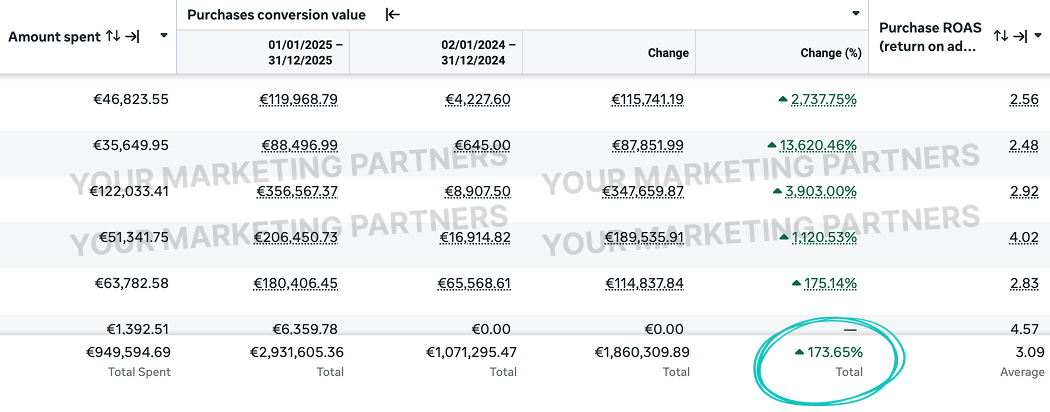
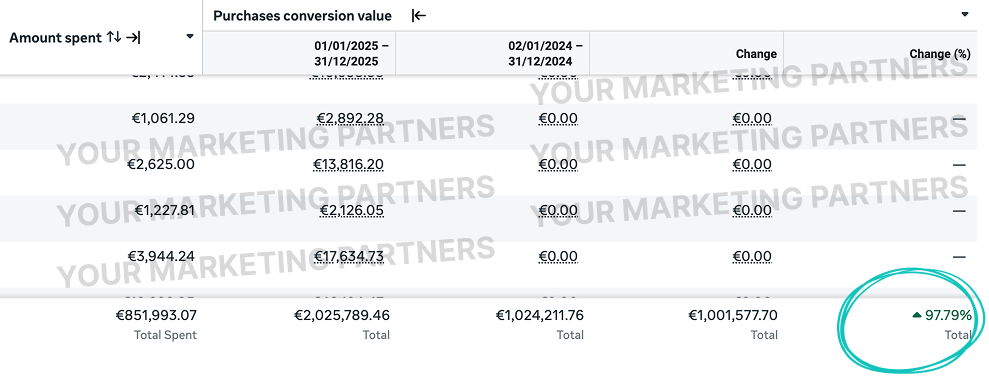
Continuous OptimisationSee What We've Done For Other Brands.
Ready to stop guessing?
Apply for a free Paid Ads Audit + Custom Scaling Plan Powered By Our Predictable Scaling Quadrant™ Method. We'll pinpoint exactly where your budget is leaking and show you a clear path to profitable scale.
Joined by 1,500+ businesses