
Reduced CPL 17% And Grew Volume 28% In 30 Days.
A US business funding broker had been running a generic "Get Funded Fast" play to every business owner audience Meta could find, same creative, same pitch, same form across trucking, restaurant, contractor, ecom, and everything else. Inside a 30-day sprint we split creative by industry vertical, replaced the broker-voice ads with founder-to-founder language, and inserted basic business-eligibility gating on the form. Lead volume climbed 28% and CPL dropped to $60.37.
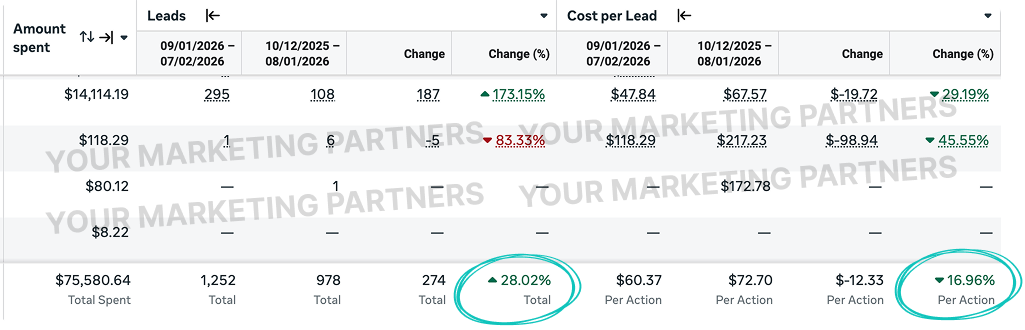
- Split the account by industry vertical, trucking, restaurant, contractor, ecom, each with its own creative, use-of-funds angle, and pre-qualifying questions. Stopped pitching a single generic offer to fundamentally different businesses.
- Killed the broker-voice creative. Rebuilt around founder-to-founder language, peers talking about cash flow, payroll, and growth bottlenecks, because business owners don't buy from brokers, they buy from people who sound like them.
- Built a use-of-funds creative library: equipment purchase, inventory, payroll bridge, expansion, working capital. Each one was a different emotional moment and the creative finally reflected that.
- Inserted business-eligibility gating at the form level, time in business, monthly revenue, industry, so the leads hitting the sales floor were actually fundable, not curious tyre-kickers.
A B2B Funding Offer Being Marketed Like A B2C Loan.
The brand had a real funding product, real lender relationships, and a sales team capable of closing the right kind of lead. What it didn't have was an account designed for B2B reality. Every campaign was using consumer-style targeting and a consumer-style "Get Approved Fast" pitch, to an audience of business owners whose decision criteria, language, and intent looked nothing like a consumer borrower.
Generic "Get Funded" Across Every Industry
A trucking company looking for equipment financing has nothing in common with a restaurant looking for working capital or a contractor needing a payroll bridge. The account was running one creative library across all of them. The generic "Get Funded Fast" hook spoke to none of these business owners specifically, and the algorithm was being asked to find conversion across a spread so wide that no single piece of creative could do the job.
Broker-Voice Creative In A Peer-Trust Category
Every concept sounded like a broker selling to a borrower, "Pre-Approved Up To $500k," "Apply Now, Funded in 24 Hours." Business owners aren't buying from brokers; they're buying from people who understand the operational reality they live in. Cash flow gaps, payroll panic, equipment breakdowns, growth bottlenecks. None of that emotional reality was anywhere in the creative.
One "Get Approved" Offer For Many Different Funding Needs
The same hook was being used regardless of what the business actually needed funding for. Equipment, inventory, expansion, cash flow, payroll, marketing, these are distinct emotional moments and distinct buying intents, and the account was speaking to none of them as such. The most powerful creative angle in business funding, use of funds, was being left on the table.
No Pre-Qualification On The Basics
The form was capturing anyone who clicked "Apply" with no eligibility gating. A meaningful share of leads were under the minimum thresholds the lender partners actually fund against, too new in business, monthly revenue too low, wrong industry profile. The sales floor was burning expensive hours on leads that should have been filtered out at submission.
30 Days, Four Tactical Shifts, Compounding Results.
A 30-day window isn't long enough for a foundational rebuild. It's exactly long enough for four tightly-scoped tactical shifts that compound on each other. We picked the four with the most leverage in business funding specifically and shipped all of them inside the sprint.
Industry-Vertical Creative Split
Restructured the account by industry vertical:
- Trucking / transportation, equipment financing, fuel/maintenance cash flow, owner-operator angles
- Restaurant / hospitality, seasonal cash flow, equipment, expansion, inventory
- Contractor / construction, payroll bridges, equipment, materials, bonding requirements
- Ecommerce, inventory financing, seasonal cash flow, ad spend bridges
Each vertical got its own dedicated campaign, creative library, audiences (lookalikes off existing funded customers within each industry), and form variant with industry-specific qualifying. The algorithm finally had something distinct to optimise toward in each segment, and conversion rates moved meaningfully on every vertical that previously had been buried inside the generic campaign.
Industry Vertical ArchitectureFounder-To-Founder Voice
Killed the broker-language creative. Rebuilt around peer voice:
- Founders / business owners speaking directly to camera about the cash flow moment they were trying to solve
- Real examples of why they needed funding ("payroll was due Friday, AR was due in 14 days")
- Operational specificity that broker-language ads couldn't fake, what the funds were used for, what the outcome was, what didn't work before
- Industry-specific creators where the founder couldn't carry it (trucking creators for trucking, restaurant operators for restaurants)
Business owners stopped scrolling because for the first time, the ads sounded like someone they'd actually take a call from.
Founder Voice CreativeUse-Of-Funds Creative Library
Built a creative library segmented by use of funds, the actual moment the business owner is sitting with the decision to seek funding:
- Equipment, "When the truck/oven/machine breaks and you can't wait 6 weeks"
- Inventory, "Ahead of the season your suppliers won't extend on"
- Payroll bridge, "Friday's coming and the AR isn't here yet"
- Expansion, "The location's available now, the bank decision is in 90 days"
- Working capital, "The flexibility to take the opportunity when it appears"
Each use-of-funds angle ran across the vertical tracks, creating a matrix of (industry × use case) creative that was finally specific enough to drive real intent. The algorithm picked the combinations that worked per vertical and scaled them.
Use-Of-Funds LibraryEligibility Gating At The Form
Inserted three pre-qualifying questions at the front of the lead form before the rest of the application:
- Time in business (under 6 months exited gracefully)
- Monthly revenue band
- Industry
Prospects under the minimum thresholds were routed to educational content and added to a nurture list for later (didn't burn them, didn't waste sales time). Qualified prospects continued into the full application with their answers pre-populated. Lead quality moved within days, and within the 30-day window Meta started finding more qualified leads because the algorithm was finally getting clean signal on what a fundable applicant actually looked like.
Eligibility Gating
Ready to stop guessing?
Apply for a free Paid Ads Audit + Custom Scaling Plan Powered By Our Predictable Scaling Quadrant™ Method. We'll pinpoint exactly where your budget is leaking and show you a clear path to profitable scale.
Joined by 1,500+ businesses