
3.4x Revenue Growth In 12 Months
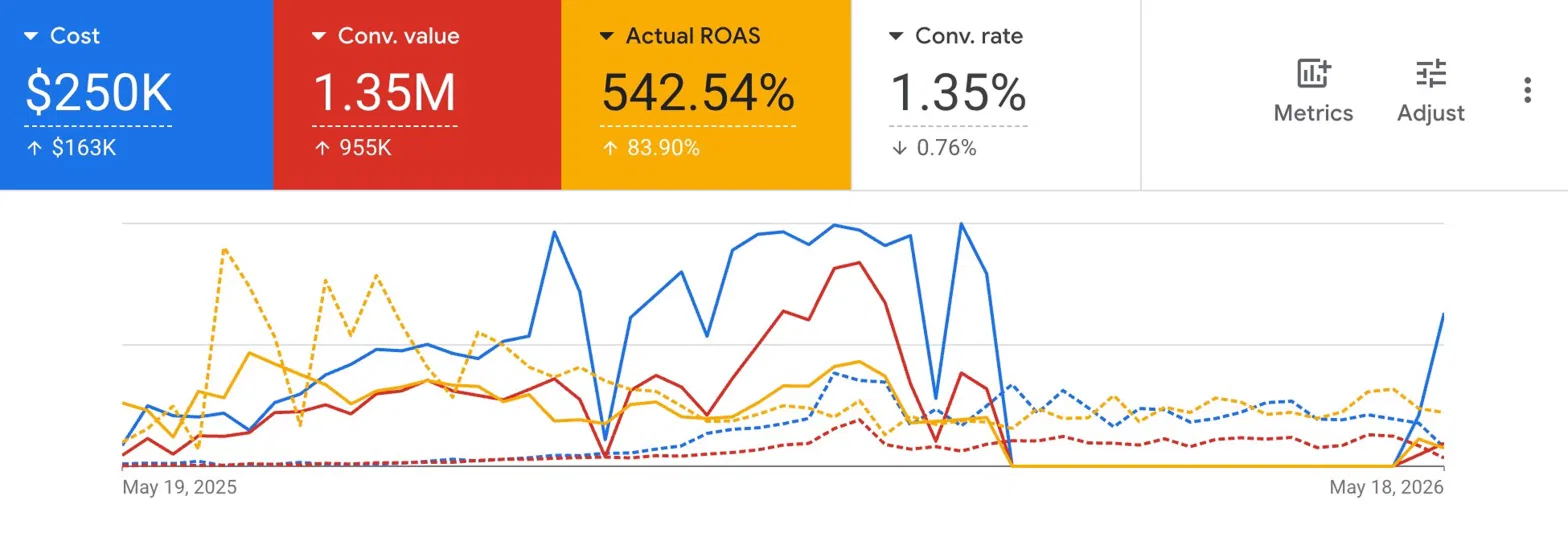
A DTC food brand had been growing on Meta for two years and had pushed Google Ads spend up to a meaningful monthly run rate, but Google was carrying a fraction of its potential. The account was a subscription business being run like a one-shot ecom store: bidding on existing subscribers, ignoring downstream LTV, and treating every first-order conversion as equal. Twelve months after a full rebuild centred on subscription economics, the brand scaled from $395K to $1.35M in revenue (a 3.4x lift) at a sustained 5.43x ROAS.
- Identified and shut down ~22% of "conversions" that were existing subscribers logging in or managing their accounts. PMax and brand search had been claiming credit for renewals as if they were new acquisitions.
- Switched the conversion event from "first order placed" to "second order placed," the order that actually proves a subscription customer, not the trial that 40% cancelled before billing.
- Rebuilt the offer ladder in the account: budget weighted toward the entry SKUs the brand's data showed produced the highest 90-day retention, not the SKUs with the lowest first-order CPA.
- Added a Performance Max campaign exclusively for upsell and cross-sell of existing active subscribers (bigger bundles, add-ons), targeting an entirely different ROAS profile than acquisition.
A Subscription Business Being Measured Like A One-Shot Ecom Store.
The brand made most of its margin on the second, third, and fourth order, classic subscription economics. But the account was measuring success by first-order acquisition CPA, ignoring whether those acquired buyers ever placed a second order. ~40% of first-order subscribers were cancelling before the second billing cycle, but the ad account couldn't see that. It had already counted the conversion and moved on.
Existing Subscribers Counted As New Acquisitions
The biggest single leak: PMax and brand search were both bidding on queries like "[brand] login," "[brand] cancel subscription," "[brand] account," "[brand] update card." Existing subscribers were clicking these ads, completing account actions, and Google was attributing the resulting subscription renewals or upsells to paid acquisition. The account looked like it was acquiring new customers; in reality, a significant share of reported conversions were existing subscribers Google had served an ad to on their way to logging in. Real cold-acquisition CPA was buried under inflated reported numbers.
Optimising For The Wrong Conversion Event
The conversion event being optimised against was "first order placed," which fired the moment a buyer signed up for the trial subscription. But ~40% of those buyers cancelled before the first paid billing cycle, meaning Smart Bidding was being trained to favour the type of buyer who signs up and bails over the type of buyer who actually becomes a subscriber. The account had been busily optimising itself toward worse retention for months.
Entry SKU Mix Working Against The Brand
The brand offered three entry bundle sizes: 7-meal trial, 14-meal trial, and 21-meal trial. PMax was bidding hardest on the 7-meal trial because it had the lowest first-order CPA, but the brand's own retention data showed 7-meal buyers had a 18% second-order rate, while 14-meal buyers had a 51% rate and 21-meal buyers a 67% rate. The account was actively pushing buyers toward the entry product that produced the worst customers.
No Subscriber Lifecycle Layer
The account had no campaigns at all aimed at existing active subscribers: no upsell to bigger bundles, no cross-sell of add-on products, no winback of recently-lapsed subscribers. The brand's biggest LTV unlock (moving a 14-meal subscriber to a 21-meal subscriber, or adding a snack pack to their order) was getting zero paid support.
We Made The Account Match The Actual Economics Of The Business.
The brand didn't need more spend. It needed Google to stop paying for traffic the brand was already going to get, stop optimising for the wrong customer, and start treating the subscription as a subscription. Every change was about realigning the account to the way the business actually made money.
Existing-Subscriber Leak Closure
Uploaded the brand's full active subscriber list as a customer match exclusion across PMax and Search. Added comprehensive negative keyword lists at the account level: account-management terms, subscription-cancellation queries, login-related searches, and direct competitor names that had been eating non-converting budget. Within 30 days, ~22% of the previous month's "conversions" disappeared from reporting, those were existing subscribers Google had been claiming credit for. CPA on real acquisition became visible for the first time.
Leak ClosureConversion Event Switched To Second Order
Moved the primary optimisation conversion from "first order placed" to "second order placed." Smart Bidding stopped being rewarded for finding cheap trial sign-ups and started being rewarded for finding buyers who actually became subscribers. Within 60 days, first-order CPA rose 14% on paper, but the second-order rate climbed from 60% to 78%, and the cost per genuine subscriber dropped meaningfully. The account was finally optimising for the customer the business actually wanted.
Conversion EventBudget Reweighted Toward Retention-Producing SKUs
Restructured asset groups around the brand's retention data. The 14-meal and 21-meal trial bundles, the SKUs with 51% and 67% second-order rates, got dedicated asset groups with the largest budget allocation. The 7-meal trial was retained but heavily deprioritised, with budget capped and creative aimed at buyers Google's signal data identified as high-commitment from the start. PMax stopped chasing the cheapest trial sign-up and started chasing the buyer most likely to stick.
Retention-Weighted BudgetDedicated Subscriber Lifecycle Campaign
Built a separate Performance Max campaign exclusively for active subscriber upsell and cross-sell, with the existing-subscriber list now used as an inclusion rather than an exclusion. Creative and offers were aimed at moving 14-meal subscribers to 21-meal, attaching snack packs and add-on products to recurring orders, and reactivating subscribers who'd paused within the last 30 days. ROAS target for this campaign was set at 8x+ to reflect the high conversion rate of an existing-customer audience. Over 12 months, this combination of leak closure, conversion event realignment, retention-weighted budget, and dedicated subscriber lifecycle scaled the account from $395K to $1.35M in revenue (a 3.4x lift) while lifting ROAS by 84% against the prior period.
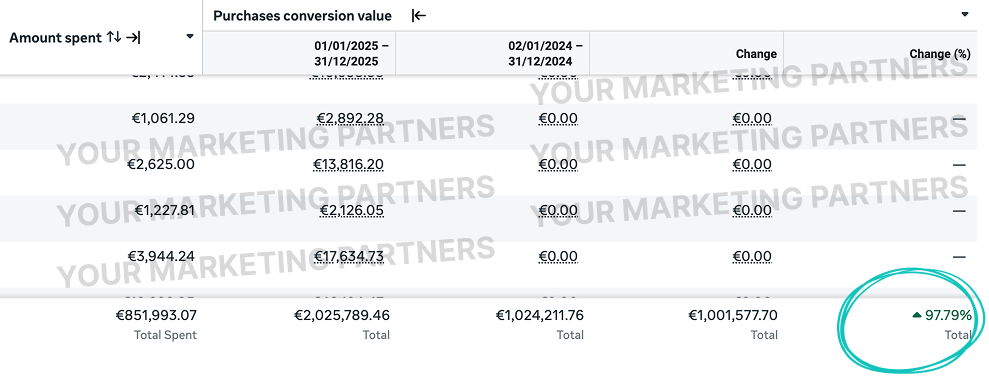
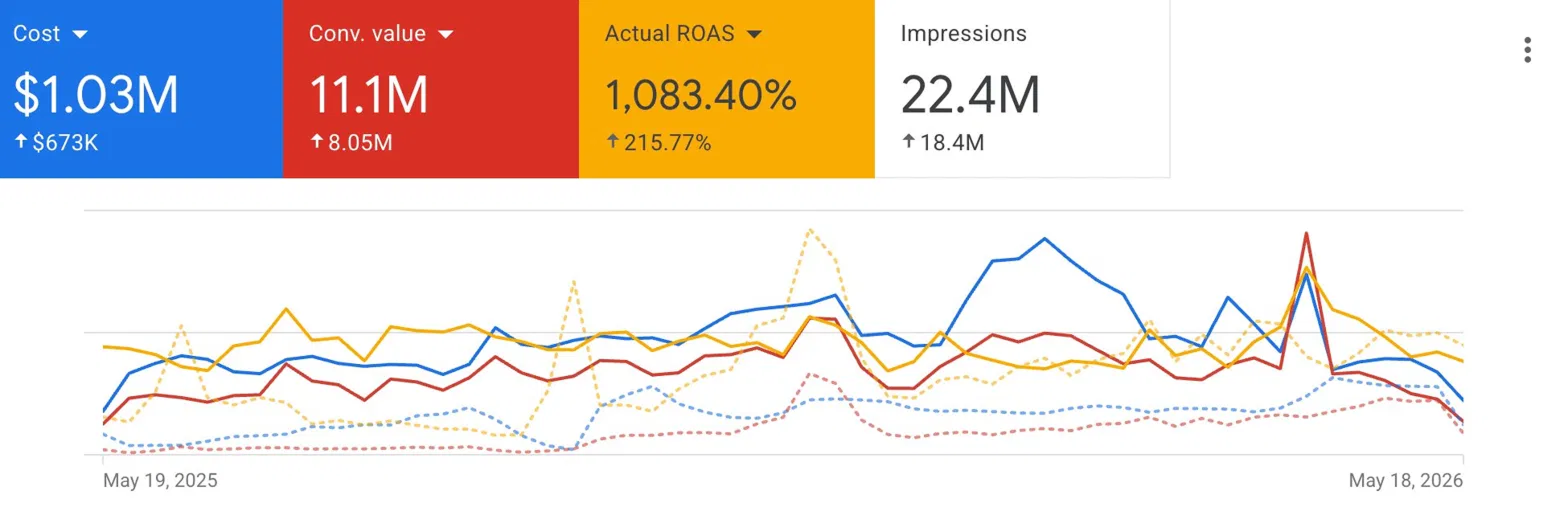
Subscriber LifecycleSee What We've Done For Other Brands.
.webp)
Ready to stop guessing?
Apply for a free Paid Ads Audit + Custom Scaling Plan Powered By Our Predictable Scaling Quadrant™ Method. We'll pinpoint exactly where your budget is leaking and show you a clear path to profitable scale.
Joined by 1,500+ businesses