
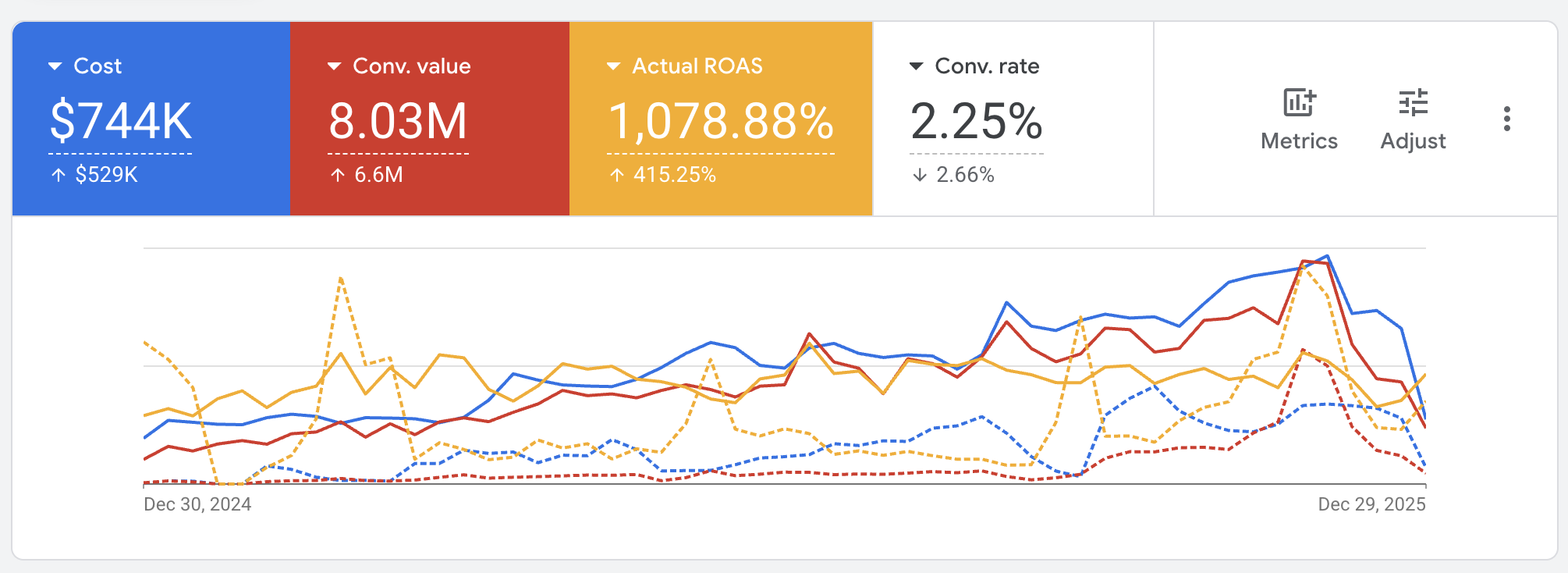
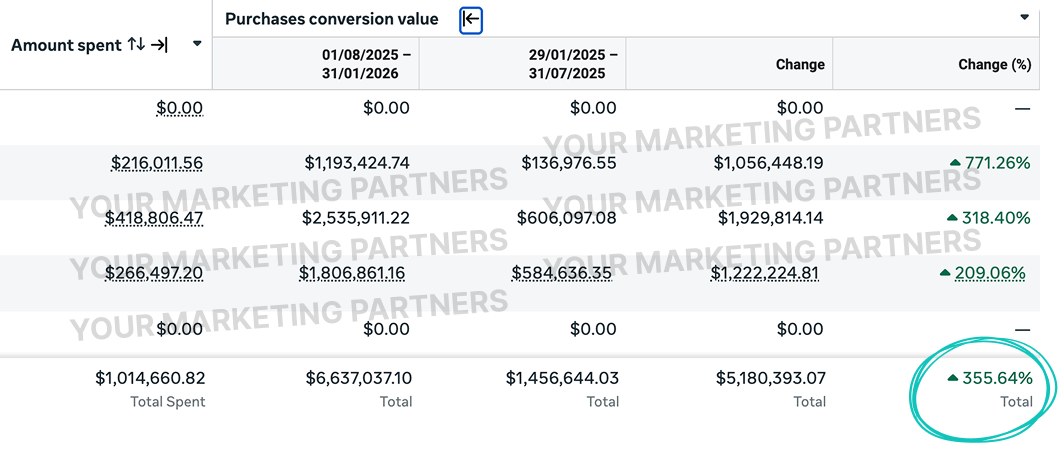
$685K In Additional Revenue In 11 Months
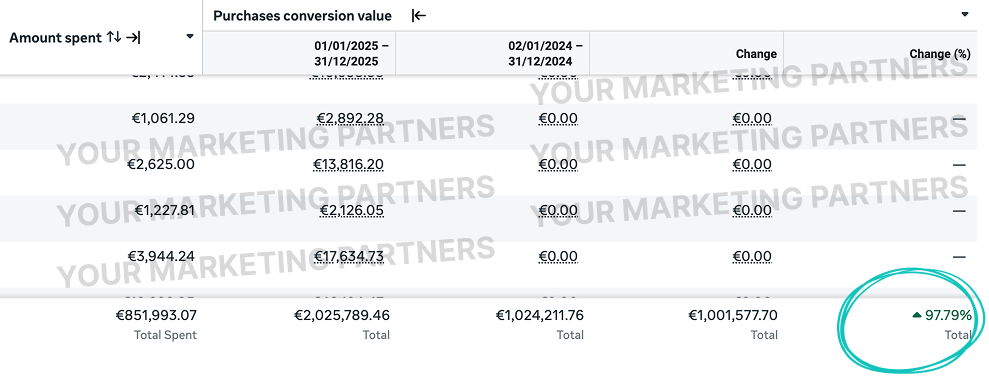
A US food and drink brand was running a Meta account optimised for first-order conversion in a category where the entire economics live in repeat purchase. New prospects were being pushed to full-price single-SKU PDPs, subscription was a passive option no one was actively converting toward, and the team's own LTV data was sitting in a spreadsheet instead of feeding the algorithm. Eleven months after rebuilding the offer around a trial-priced variety pack, building active subscription conversion into every touchpoint, and wiring cohort LTV back into Meta as the bidding signal, revenue grew 88% YoY at a 3.16x ROAS.
.png)
- Made the variety pack the cold-acquisition hero at a trial price, eliminated the "what if I don't like it" friction that was killing first-purchase conversion on full-price single SKUs.
- Built active subscription conversion into every touchpoint, PDP, post-purchase, email/SMS nurture, and dedicated retargeting tracks, instead of leaving subscription as a passive checkbox.
- Wired cohort LTV data back into Meta via offline conversion events. The algorithm stopped chasing the cheapest first-order purchaser and started finding the customer profiles that actually compound.
- Built a use-case creative library that expanded consumption occasions, morning, post-workout, sharing, recipe applications, instead of running endless product-shot variations of the same hero ad.
A Repeat-Purchase Business Optimised For First-Purchase Economics.
The brand made money on repeat customers. The Meta account was being run as if it made money on first orders. That single mismatch was distorting every downstream decision: the offer was wrong for cold acquisition, subscription was a passive afterthought, the team's own LTV data wasn't flowing back to the algorithm, and the creative was selling the product instead of selling the use case.
First Order Treated As The Win
Every campaign was optimised on Purchase, and the team was reporting first-order ROAS as if it were the full picture. The actual unit economics of the business sat in the second, third, fifth order, where margin lived and where the LTV/CAC math actually worked. By optimising for cheap first-purchases, Meta was finding customers who'd try once and never come back, while the customer profiles that actually drove the business were getting under-served.
Single-SKU Acquisition When The Sampler Was The Right Front Door
Cold traffic was being driven to single-product PDPs at full retail price. For a consumable brand where flavour preference is a real conversion barrier, this is structurally backwards. The variety pack, pre-positioned at a trial price, removes the "what if I don't like it" objection in one move. The brand had a variety pack in its catalogue and it was sitting buried as a non-hero SKU.
No Subscription Conversion Layer
Subscription was available on the website. That was the extent of the subscription strategy. No active conversion mechanic from one-time buyer into subscriber. No post-purchase upsell. No email/SMS sequence built to move someone from trial to recurring. The single highest-leverage move in any consumable business, turning a buyer into a subscriber, was being left entirely to chance.
LTV Data Stuck In A Spreadsheet
The team knew the 60-day, 90-day, and 180-day repeat rates. They knew which customer profiles were most likely to subscribe. They knew which SKUs drove the highest LTV. None of that data was flowing back to Meta. The algorithm was being asked to find purchases, not high-LTV cohorts, because the only signal it was receiving was first-order conversion.
Creative Selling The Product, Not The Use Case
Every concept was a hero shot of the product with a "buy now" overlay. Almost nothing showed when the product fit into a real day, how it was used, or what occasion it solved. For a consumable, occasion creative is what expands consumption, and the account was producing none of it.
Stop Optimising For Cheap First Orders. Build For Subscribers.
The strategic shift behind the whole engagement: the win condition wasn't "more first-time buyers." It was "more subscribers." Once the offer, the funnel, the optimisation signal, and the creative all aligned to that, the cost curve started to behave the way LTV economics actually let it behave.
Sampler / Variety Pack As Cold-Acquisition Hero
Restructured the offer architecture so cold traffic met the variety pack first, at a trial price designed to remove first-purchase risk:
- Promoted the variety pack as the primary front door in cold creative
- Trial-priced the cold-acquisition SKU to a deliberate first-order loss with the LTV math behind the decision
- Repositioned single SKUs as the upsell after the trial, not the entry point
- PDP redesigned around "try everything" framing rather than "buy this one"
First-purchase conversion rate moved materially because the friction of "I don't know which flavour I'll like" had been engineered out of the funnel entirely.
Sampler-First AcquisitionActive Subscription Conversion At Every Touchpoint
Built explicit subscription conversion into every step of the customer journey:
- PDP, "Subscribe & Save" positioned as the default, one-time purchase as the secondary
- Cart / checkout, subscription option surfaced inline with skip-anytime framing
- Post-purchase, immediate upsell to subscription with first-month discount
- Email/SMS nurture, dedicated one-time-to-subscriber sequence triggered after first order
- Retargeting, dedicated subscription-conversion creative for engaged one-time buyers
Subscription started becoming the default outcome of a customer relationship, not an exception. The compounding effect on LTV, and therefore on the headroom Meta had to scale spend, was the single biggest unlock of the year.
Subscription Conversion EngineLTV-Weighted Value Bidding
Fed cohort LTV data back to Meta via offline conversion events:
- Multiple conversion events firing across the customer lifecycle (First Order, Second Order, 90-Day Repeat, Subscription Started)
- Dynamic value events with actual revenue values attached, not just placeholder values
- Optimisation switched from Purchase to a higher-value cohort event with sufficient volume to train on
- Value rules weighting subscribers materially higher than one-time buyers
The algorithm stopped chasing the cheapest first-order purchaser and started actively finding the profiles that fit the LTV pattern the business actually wins on. CAC on a first-order basis went up slightly. CAC on a 180-day basis came down materially.
LTV-Weighted BiddingUse-Case Creative Library
Replaced product-hero creative with a library built around occasions and use cases:
- Morning routine, energy, focus, kick-start framing
- Afternoon pick-me-up, the 3pm slump moment
- Post-workout, recovery, refuelling, hydration context
- Sharing / social, friends, gatherings, hosting framing
- Recipe applications, actual use cases that expand what the product is "for"
Each occasion ran as its own concept track with its own hooks, formats, and creator partnerships. The library expanded the addressable use cases of the product, which is what actually expands a consumable category, instead of relentlessly retargeting the same audience with the same hero shot.
Use-Case Creative LibrarySee What We've Done For Other Brands.
Ready to stop guessing?
Apply for a free Paid Ads Audit + Custom Scaling Plan Powered By Our Predictable Scaling Quadrant™ Method. We'll pinpoint exactly where your budget is leaking and show you a clear path to profitable scale.
Joined by 1,500+ businesses