
2x Conversion Volume While Cutting CPL By 14%
A US moving company was approaching its peak window (May–September drives the majority of annual moves) with a flat year-round account, a quote form that was bleeding conversions, and no plan for the demand surge other than "spend more." Six months later, with most of the work done before peak even started, they'd generated 10,814 leads at $97 CPL, doubling lead volume while bringing CPL down from $112.78 to $97.13.
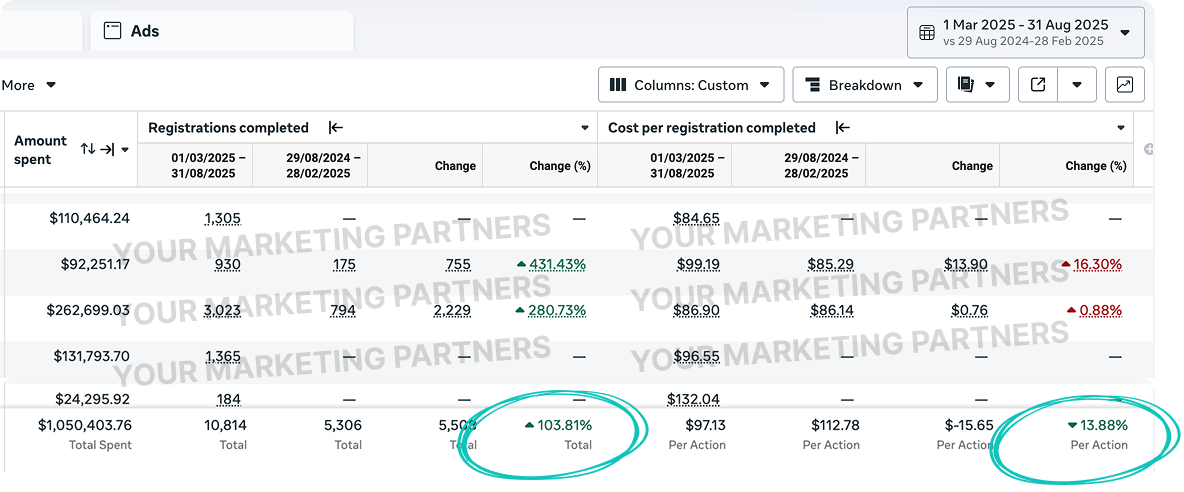
- Treated peak season as a project, not an event. Spent 6 weeks before peak rebuilding the account, creative, and funnel so the team could push spend without scrambling once demand hit.
- Rebuilt the quote form from a 14-field wall into a multi-step, mobile-first flow with smart logic, form completion rate moved materially without changing a single ad.
- Split local, long-distance, and commercial moves into separate campaigns with their own creative, landing pages, and forms. Stopped treating three different buyers as one audience.
- Reset bidding for the demand window, removed manual bid caps that were stopping the account from competing in peak auctions when CPL economics were actually most favourable.
A Seasonal Business Running A Year-Round Playbook.
Moving is one of the most seasonal categories in lead gen, May to September drives a disproportionate share of annual revenue, and the brands that dominate the category are the ones who prepare for the window, not the ones who react to it. This account was doing none of that. The team was treating peak like any other quarter, the funnel was leaking conversions at every step, and the most expensive auctions of the year were about to start with the account in no shape to compete.
No Seasonal Strategy In A Brutally Seasonal Category
The account had been running flat year-round, same campaigns, same creative, same budget logic in February as in July. No pre-warming of audiences ahead of peak. No creative refresh keyed to the demand window. No agreed budget ramp tied to when leads were actually worth most. The team had effectively been hoping peak would happen to them.
The Quote Form Was Killing The Click
The on-site quote form was a 14-field wall on a single page: name, email, phone, current address, destination address, move date, move size, special items, parking access, stairs, packing services, storage needs, preferred contact method, hear-about-us. No multi-step structure. No progress indicator. No mobile-first treatment despite the majority of traffic being mobile. Completion rate was well below category benchmark, meaning the team was paying for clicks they then immediately lost on the form.
One Account, Three Different Buyers, One Generic Pitch
Local moves, long-distance moves, and commercial moves were all running in the same campaigns against the same audiences with the same creative. They are three fundamentally different buyers, different urgency, different price expectation, different objection set, and the generic "Get a Free Moving Quote" ad was speaking to none of them properly. Local movers wanted a date and a price; long-distance movers wanted to know who handles the truck; commercial movers wanted insurance and night/weekend availability.
Bidding Locked Out Of Peak Auctions
Every active ad set had a manual bid cap set during the prior winter to "protect CPA." The result: when peak demand started pulling auction prices up, the bid caps locked the account out of the inventory the brand most needed to be winning. Spend was rolling off exactly when the leads were most valuable downstream.
Win Peak By Preparing For It, Not By Reacting To It.
The work that doubled the year wasn't done during peak. It was done in the six weeks before peak. Once the demand window opened, the team's only job was to scale the things that were already in place.
Peak Preparation Sprint (Mar–Apr)
Six weeks of foundation work before the first May lead. Built the creative library (3 service lines × 4–5 concepts each), rebuilt the campaign structure, rewrote the landing pages, set up new tracking, briefed the sales team on what was coming. The deliverable wasn't "more leads", it was "an account ready to take 2x spend the day peak starts without anything breaking." Everything downstream depended on this being done early.
Pre-Peak SprintQuote Form Rebuild
Replaced the single 14-field page with a multi-step flow:
- Step 1: Move type, date, move size (3 fields, low friction)
- Step 2: Origin and destination (2 fields, autocomplete)
- Step 3: Contact details (3 fields, after commitment is built)
- Progress indicator at the top so users could see how short it was
- Mobile-first treatment with large tap targets and number-pad keyboards on phone fields
- Smart logic: commercial movers skipped residential-specific questions, long-distance skipped local-specific questions
Form completion rate moved materially in the first month. Same ads, same spend, more leads, and the lift compounded across every campaign in the account because the bottleneck wasn't the ads, it was the form.
Quote Form CROService-Line Separation
Split the account into three parallel funnels:
- Local moves, speed and price-led creative ("Same-day quotes. Crews available this weekend."), short-form video on local job sites, geo-tight targeting around metro service areas
- Long-distance, trust and process-led creative ("Your stuff, one truck, one crew, all the way."), longer-form explainers, broader geo, higher-intent landing page with route map and insurance prominence
- Commercial, B2B angle ("After-hours office moves with full insurance and dedicated PM."), separate form with B2B-specific qualifying fields, retargeting layer built off LinkedIn-style intent signals
Each got its own creative, its own landing page, its own form, and its own optimisation event. Lead quality jumped because the sales team was finally getting leads that matched what the prospect had actually clicked on.
Service-Line Campaign SeparationBid Strategy Reset For Peak
Removed every manual bid cap in the account heading into May. Moved to highest-volume bidding so the algorithm could compete in whatever auctions made economic sense, rather than being locked out of the most valuable inventory the moment auction prices rose. CPL didn't blow up, it actually came down, because the algorithm was now buying the right impressions instead of being forced into a narrow cheap band. This is the move most lead-gen accounts get wrong: holding bid caps through peak in the name of "discipline" is what causes you to miss peak entirely.
Bid Strategy ResetSee What We've Done For Other Brands.
Ready to stop guessing?
Apply for a free Paid Ads Audit + Custom Scaling Plan Powered By Our Predictable Scaling Quadrant™ Method. We'll pinpoint exactly where your budget is leaking and show you a clear path to profitable scale.
Joined by 1,500+ businesses