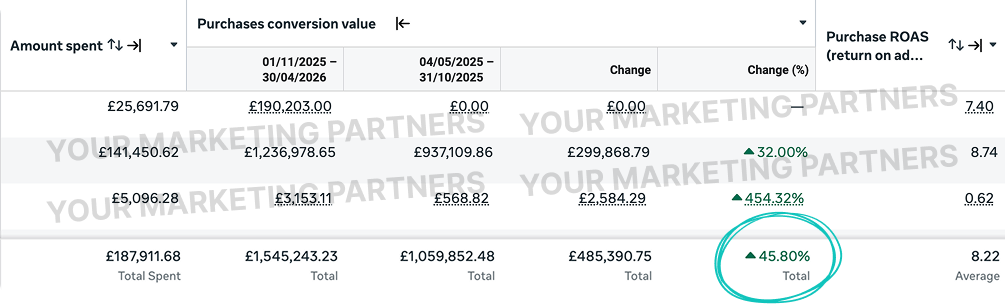
45% Revenue Growth In 6 Months
A UK gym equipment brand was selling four-figure kit through a single-conversion-event Meta account, high-intent buyers were closing, but the much larger pool of researching, comparing, "I'll come back to it" prospects was bouncing into the void. Six months after splitting the funnel into a direct-purchase track and a ManyChat-led DM nurture track, whitelisting creator partnerships at scale, and operationalising organic-to-paid as a continuous pipeline, revenue grew 46% period-over-period at an 8.22x ROAS.
- Split the account into two parallel tracks: direct-purchase campaigns for high-intent buyers ready to commit, and ManyChat-led DM nurture for the much larger "interested but not ready" pool.
- Built a ManyChat layer that triggered on creator-style ad engagement, surfacing product education, financing options, and exclusive bundles inside Instagram DMs where the conversation could actually happen.
- Treated every fitness-influencer partnership as a paid asset, not a one-off organic post. Whitelisted creator handles, extended reach with paid, and let the brand control targeting and budget on top of the creator's credibility.
- Operationalised organic-to-paid as a continuous pipeline: this year the gap between what pops organically and what works in ads has effectively collapsed, and the brands moving fastest are the ones treating organic as a free testbed for paid.
A Four-Figure Considered Purchase Being Sold As An Impulse Click.
The brand had a serious product line, racks, machines, full-platform kit, at price points well into four figures. The buyer was, by definition, doing real research: reading reviews, comparing builds, watching home-gym tour videos, weighing finance options. The Meta account was structured as if none of that were happening. Purchase campaigns, single click-through, generic landing page, hope they buy. No second touch, no DM nurture, no fallback for the 80%+ of engaged prospects who weren't going to buy on the first session.
A Single-Track Funnel For A Multi-Track Buyer
Every active campaign was Purchase-optimised. There was no separate treatment for prospects who clearly weren't ready to buy yet but were obviously engaged, saving posts, watching long-form video, commenting on creator content, DMing the brand. The account was being run on the assumption that interest = conversion-readiness, when for a £1,500+ piece of kit those two things are weeks apart.
Influencer Spend Treated As Organic Only
The brand was paying meaningful sums for fitness creators to post about the product, and the entire return on that spend was decaying inside 48 hours on the creator's grid. No whitelisting. No paid amplification. No "this is the post that's already proven it converts, let's actually buy reach against it." Influencer budget was effectively being spent on impressions the brand couldn't compound.
Organic Winners Never Tested As Paid
The brand's own organic was producing clear winners every week, Reels that broke out, posts that picked up shares, comments asking where to buy. None of it was being systematically pushed into the ad account. The thing the audience had already voted for as worth their attention was being left as a one-off organic moment instead of the spine of the next week's paid creative.
No DM Layer For The Researching Buyer
For a high-ticket purchase, a meaningful share of prospects want to talk before they buy, about delivery, about assembly, about whether the kit fits a specific space, about finance. There was no automated entry point for that conversation. The brand had Messenger and Instagram DM available; neither was wired into the funnel as a conversion path.
Treat Organic And Paid As One System, Not Two Departments.
The strategic shift behind the whole engagement: in 2026 the line between organic and paid has effectively collapsed. What's popping on organic is the cheapest, fastest, most accurate signal you have about what will work in ads. The brands moving fastest are the ones treating organic as a continuous testbed for paid, and using paid to amplify the organic moments that have already proven they earn attention.
Two-Tier Funnel: Direct Purchase + DM Capture
Restructured the account around two parallel tracks running side by side:
- Direct Purchase track, conversion-optimised campaigns for high-intent prospects (retargeting, comparison-shoppers, brand-aware audiences), driving straight to PDPs with the full purchase experience
- DM Capture track, engagement-led creative that drove warm-but-unready prospects into ManyChat-powered conversations on Instagram and Messenger, where the actual sales conversation could happen
The DM track was the unlock. For a high-ticket considered purchase, most of the value sat in prospects who weren't yet ready to click "buy" but were absolutely ready to ask a question. Giving them a way to do that on the platform they were already on, instead of asking them to commit to an email opt-in or a phone call, changed the funnel economics.
Two-Tier Funnel StrategyManyChat DM Nurture Layer
Built out the ManyChat flows for the DM track:
- Trigger: comment on a specific ad, story reply, or DM keyword
- Initial response: automated qualifier (which product, what's the space, when looking to buy)
- Branching: routes into product education, delivery/assembly info, finance options, exclusive DM-only bundles
- Human handoff for the highest-intent prospects (DMing about a £3k+ purchase doesn't get bot-only treatment)
- Tagging to feed engagement data back into Meta for retargeting
The DM layer worked because it met the buyer in the format they were already using, short, conversational, low-pressure. The kind of question someone would normally type into Google and then bounce around five competitor sites for got answered in the DM within minutes. A meaningful share of those DM conversations converted within the same week.
ManyChat DM NurtureFitness Influencer Whitelisting At Scale
Restructured every creator partnership to be a paid asset, not just an organic post:
- Whitelisting clauses written into every partnership upfront
- The best-performing pieces of creator content (by saves, shares, comments, not just views) got pushed into paid as Spark Ads / whitelisted posts under the creator's handle
- The brand controlled targeting, budget, and duration on top of the creator's existing credibility
- Performance data on creator content fed back into which creators got bigger second-round investments
The creator economy in fitness is enormous, and the brands winning in 2026 are the ones treating creator content as the raw material for their paid account, not as a one-and-done organic flex. Influencer spend stopped being a brand-marketing line item and started being a performance asset.
Influencer WhitelistingOrganic-To-Paid Continuous Pipeline
Built a weekly operating rhythm:
- Monday: review the top organic posts from the brand and creator partners over the last 7 days (judged on saves and shares, not vanity views)
- Tuesday: the standout posts get pulled into the ad account as test concepts, with proper tracking
- Wednesday–Friday: new test creative goes live in the ABO testing campaign at a controlled budget
- Following Monday: review which test concepts have broken out and graduate them into the main spend
Time from organic-winner to paid-test was rarely more than 72 hours. This is the operating model that the 2026 organic/paid convergence rewards, the brands still treating those as separate workflows are leaving the cheapest creative signal on the table.
Organic-To-Paid PipelineSee What We've Done For Other Brands.
.webp)
Ready to stop guessing?
Apply for a free Paid Ads Audit + Custom Scaling Plan Powered By Our Predictable Scaling Quadrant™ Method. We'll pinpoint exactly where your budget is leaking and show you a clear path to profitable scale.
Joined by 1,500+ businesses