
1.95x Revenue Growth In Just 12 Months
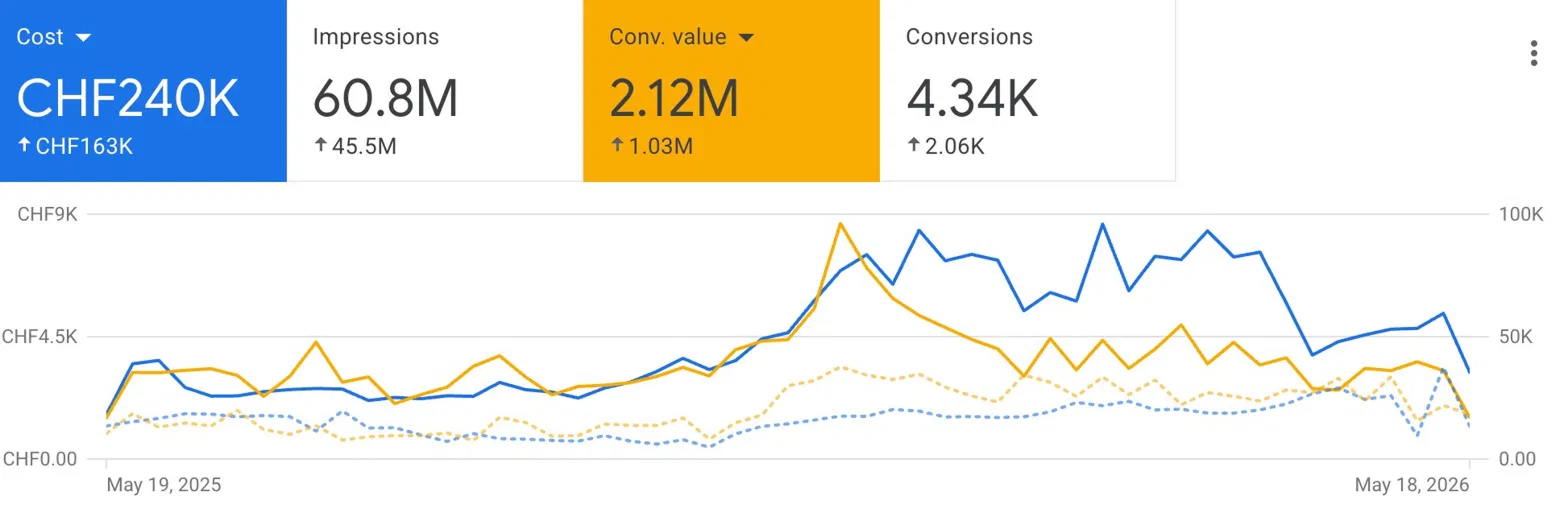
A premium watch brand had been running Google Ads for years but the account had drifted. Performance Max was operating on autopilot, the Merchant Center feed hadn't been touched since the migration, and in a category where buyers search by movement, case material, and water resistance before brand, the catalogue was functionally invisible to the queries that mattered. Twelve months after a structural rebuild and a tighter handle on feed and bidding, the account scaled from CHF 1.09M to CHF 2.12M in revenue, nearly doubling year-over-year while almost doubling conversions.
- Rebuilt the Merchant Center feed with the watch-specific attributes Google rewards in Shopping (movement type, case material, water resistance, strap material). Titles and structured data went from generic to category-leading.
- Mapped bidding strategy to the real research cycle of premium watch buyers. A 21-day data-driven attribution window replaced the default last-click, and Smart Bidding finally credited the early-funnel touchpoints that were doing the discovery work.
- Built tiered asset groups by price band (entry, mid, flagship) so Smart Bidding stopped applying one CPA target to a catalogue with three completely different unit economics profiles.
- Installed competitor conquesting through a tightly-controlled Search campaign targeting the specific competitor brands premium watch buyers cross-shop, with custom landing pages built for each comparison.
Premium Watch Buyers Don't Behave Like Ecom Buyers, But The Account Was Set Up Like They Did.
In a sub-CHF 200 ecom category, buyers see an ad, click, and convert in hours. In premium watches, the journey runs 2 to 6 weeks across multiple devices, multiple search sessions, and constant cross-shopping against three or four competitor brands. The account was using default attribution settings and a single flat CPA target across a CHF 400 to CHF 8,000 product range. The mismatch between how the category actually buys and how the account was set up to measure and bid was the central problem.
Feed Built For The Wrong Queries
Generic titles ("Men's Watch, Blue Dial") with none of the structured attributes Google's Shopping algorithm uses to match premium watch queries. No movement type, no case diameter, no strap material exposed in the feed. The brand was bidding on generic gift-search queries and missing the high-intent watch-enthusiast queries entirely: "Swiss automatic chronograph 41mm," "sapphire crystal dive watch," "GMT movement steel bracelet." ~22% of SKUs were missing GTINs or had mismatched MPNs, suppressing feed quality scores across the catalogue.
Attribution Window Killing Discovery
Default last-click attribution in a category with a multi-week consideration window meant only the final converting touchpoint got credit. Smart Bidding was being trained to favour bottom-of-funnel queries and starve the discovery placements that were actually doing the work of getting the brand into the buyer's consideration set. The campaigns generating awareness were being defunded by an algorithm that couldn't see what they were contributing.
Flat CPA Across A Massive Price Range
One target CPA applied across the entire catalogue, from CHF 400 entry-level pieces to CHF 8,000 flagship models. Smart Bidding was either over-paying for low-margin entry products or under-bidding on flagship pieces that could absorb 4x the CPA and still hit margin. The unit economics were being averaged out into a setting that worked for nothing.
No Competitor Conquesting
In premium watches, buyers explicitly cross-shop. Every consideration set includes 3 or 4 competitor brands. The account had no presence on competitor brand queries, despite the brand having a clear price-vs-spec advantage against several of them. Buyers researching "competitor X review" were finding the competitor and nothing else.
We Made The Account Behave Like A Premium Considered-Purchase Account.
The unlock wasn't more spend or smarter creative. It was getting the measurement and bidding setup to match how the category actually buys. We rebuilt the feed, fixed attribution, tiered the bidding, and added competitive presence.
Watch-Specific Feed Architecture
Rewrote every product title to lead with the attributes premium watch buyers search for: movement type, case material, case size, then collection and model. Added structured attributes across the feed (water resistance rating, strap material, dial colour, complications) so Google could match the catalogue against high-intent enthusiast queries. Within 30 days, Shopping impression share on non-brand watch-specification queries climbed materially and the brand started appearing on the searches that drive premium watch purchases.
Feed ArchitectureAttribution Window Aligned To Real Buyer Behaviour
Switched from last-click to data-driven attribution with a 21-day conversion window, matched to the average research cycle observed in the brand's own GA4 data. Discovery placements that had been invisible suddenly showed their contribution to the conversion path. Smart Bidding stopped starving the top-of-funnel and started crediting the touchpoints that were doing the discovery work, which meant it kept bidding into them rather than choking them off.
AttributionTiered Bidding By Price Band
Split the catalogue into three Performance Max campaigns by price band: entry (CHF 400-1,200), mid (CHF 1,200-3,500), flagship (CHF 3,500+). Each got its own target ROAS aligned to the unit economics of that price tier. The flagship campaign could now absorb a CHF 600 CPA (impossible under the flat target), and the algorithm started actively chasing the high-AOV buyers the brand had been leaving on the table. Within 60 days, average order value across paid acquisition climbed 18%.
Tiered BiddingCompetitor Conquesting Campaign
Built a dedicated Search campaign targeting the 4 competitor brands the brand's buyers most commonly cross-shopped, with bespoke landing pages for each: a head-to-head spec comparison, not a generic product page. Tight match types, aggressive negative keywords, and custom ad copy that named the comparison directly. Conquesting traffic converted at 2.3x the rate of generic non-brand traffic because the buyer was already deep in research. Over 12 months, this combination of feed precision, attribution realignment, price-band bidding, and competitive presence almost doubled the account year-over-year, from CHF 1.09M to CHF 2.12M, with conversions climbing from 2.28K to 4.34K.
Competitor ConquestingSee What We've Done For Other Brands.
.webp)
Ready to stop guessing?
Apply for a free Paid Ads Audit + Custom Scaling Plan Powered By Our Predictable Scaling Quadrant™ Method. We'll pinpoint exactly where your budget is leaking and show you a clear path to profitable scale.
Joined by 1,500+ businesses