
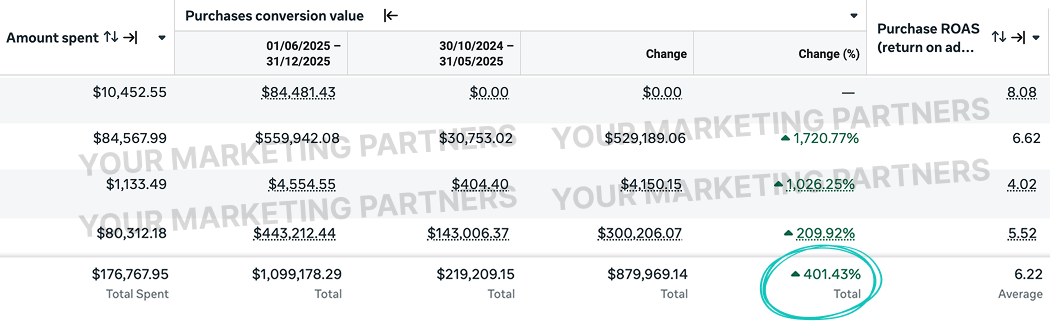
$880K In Additional Revenue In 7 Months
A US jewellery brand was running one funnel for three completely different buyers, impulse self-purchasers shopping under $200, considered self-purchasers in the $500–1500 range, and partners buying high-ticket gifts at $1500+. The craftsmanship story that should have been the brand's primary differentiator was buried in the PDP footer, and the sizing/returns anxiety that kills jewellery conversion wasn't being addressed anywhere in the funnel. Seven months after splitting the account into price-tier-specific funnels, building a dedicated gifter track, and putting materials and craftsmanship at the front of every creative, revenue grew 5x at a 6.22x ROAS.
- Split the account into three price-tier funnels, impulse (<$200), consideration ($500–1500), and high-ticket ($1500+), each with its own creative, urgency mechanic, and trust signals.
- Built a dedicated gifter track that addressed the unique anxiety of buying jewellery for someone else, sizing confidence, return guarantees, "she'll love it" social proof, and a built-in size-check flow.
- Moved the craftsmanship and materials story to the first three seconds of every concept. The brand's real differentiation, ethics, sourcing, finishing, became the hook, not the disclaimer.
- Killed sizing and returns anxiety with a free ring-sizer lead magnet, in-creative return policy callouts, and an interactive sizing tool on every PDP.
One Funnel, Three Buyers, Sizing Anxiety Killing Everything.
The brand had real product range and real margin, but the Meta account was treating every prospect as one buyer with one decision profile. An impulse buyer hunting a $120 chain doesn't behave anything like a partner trying to spend $2,400 on an anniversary piece, and neither of them buys the way a self-purchasing customer evaluating a $700 ring does. The account had been built without that segmentation in mind, and the result was a creative library that was middle-of-the-road for everyone and exactly right for no one.
One Funnel For Three Price Tiers
Sub-$200, $500–1500, and $1500+ purchases all ran through the same campaign structure, the same creative library, and the same retargeting flow. Impulse buyers were being served considered-purchase creative; high-ticket prospects were being asked to make four-figure decisions inside the same funnel built for impulse buys. The urgency mechanics, trust signals, and proof points each tier actually needed were nowhere differentiated.
The Gifter Was Buying Blind
A meaningful share of the revenue came from partners buying for someone else, and they were doing so with no support. No confidence on size. No way to verify style preference. No clear "if she doesn't love it" return path surfaced in the funnel. Gifter conversion is one of the highest-intent traffic types jewellery brands see, and this one was being treated identically to self-purchase traffic, losing exactly the customers who'd come closest to converting.
Craftsmanship Story Buried
The brand had real differentiation in its category, material quality, ethical sourcing, finishing standards, design provenance. None of it was in the creative. Every concept led with a hero product shot that looked like any competitor's. The brand was paying to compete on visual aesthetics in a category where aesthetics are commoditised and the story behind the piece is the actual conversion lever.
Sizing And Returns Anxiety Going Unaddressed
For jewellery, and especially for rings, the question "what if it doesn't fit" sits in the back of every buyer's head. The PDP made no concerted effort to remove that friction. No sizing tool. No free sizer offer. No prominent return-policy callout. Add-to-cart to purchase conversion was bleeding at exactly the point a few specific reassurances would have closed the gap.
Stop Selling To "Jewellery Buyers." Build For The Buyer In Front Of You.
The shift was about treating three different buyer realities as three different funnels, addressing the gifter as a unique customer instead of a self-purchase variant, and surfacing the things that actually move a jewellery buyer's decision, craftsmanship and confidence, to the front of every interaction.
Price-Tier Funnel Architecture
Split the account into three distinct funnels:
- Impulse (<$200), short-form, fast hooks, social proof and trend-led framing. Direct to PDP. Light retargeting cycle. Cold-to-purchase same-session.
- Consideration ($500–1500), multi-touch creative, education-led, materials and craftsmanship leading. Longer retargeting cycle with proof-point sequencing. Email + SMS nurture layer for engaged-but-unconverted traffic.
- High-Ticket ($1500+), high-touch funnel with VSL-style creative on the product story, optional sizing consultation, white-glove return guarantee, founder/maker-voice creative. Longer attribution window assumed and built for.
Each tier had its own creative library, its own audience strategy, its own retargeting flow, and its own optimisation event. The algorithm got clean signal per tier instead of averaging across a wildly different intent spread.
Price-Tier Funnel ArchitectureDedicated Gifter Track
Built a specific funnel for the partner buying as a gift:
- Creative variants that explicitly named the gifter ("Buying for her? Here's how to get it right")
- Sizing guidance built in, printable ring sizer, "how to find her ring size without asking" guide, size-exchange guarantee
- Style cues, "she'll love it if she wears…" framing that helped the gifter confirm taste without giving the surprise away
- Visible return promise, extended return windows for gifts, exchange protections, the reassurance that takes "what if she doesn't like it" off the table
- Gift-specific landing experience, gift wrapping, gift message at checkout, delivery date control
Conversion rate on gifter traffic moved meaningfully, and the gifter buyer became one of the most profitable segments in the account, because the small set of specific anxieties keeping them from buying had finally been engineered out of the path.
Dedicated Gifter TrackCraftsmanship-Led Creative Spine
Rewrote every creative brief so the craftsmanship and materials story led, not trailed. The first three seconds of every concept had to carry a beat from the brand's actual differentiation:
- Material specifics (solid 14k, conflict-free stones, recycled gold)
- Sourcing and ethics callouts
- Hands-on finishing footage
- Maker / founder voice on why the piece is built the way it is
Hero product shots still played a role, but as the answer to the story, not the opening line. In a visually-saturated category, what makes a jewellery brand actually distinctive is the story behind the piece. Saying that out loud, early, repeatedly, was the single biggest creative unlock of the engagement.
Craftsmanship-Led CreativeSizing & Returns Friction Removal
Killed the sizing and returns anxiety at every step:
- Free ring sizer offered as a lead magnet, captured email, served as a low-friction first interaction, and pre-qualified intent
- Interactive sizing tool built into every ring PDP, width, fit, comparison to common reference points
- Return policy callouts placed prominently in creative, on PDPs, and in checkout, not buried in a footer link
- Lifetime resize and 30-day no-questions returns surfaced as creative hooks for the consideration and high-ticket tiers
The same traffic started converting at materially higher rates because the question that had been quietly killing the sale was finally being answered before it was asked.
Sizing & Returns Friction Removal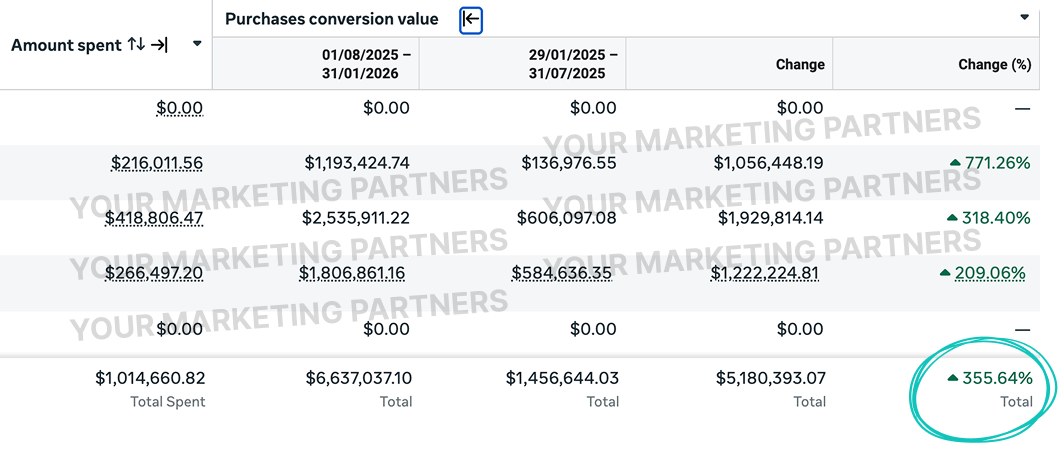
Ready to stop guessing?
Apply for a free Paid Ads Audit + Custom Scaling Plan Powered By Our Predictable Scaling Quadrant™ Method. We'll pinpoint exactly where your budget is leaking and show you a clear path to profitable scale.
Joined by 1,500+ businesses